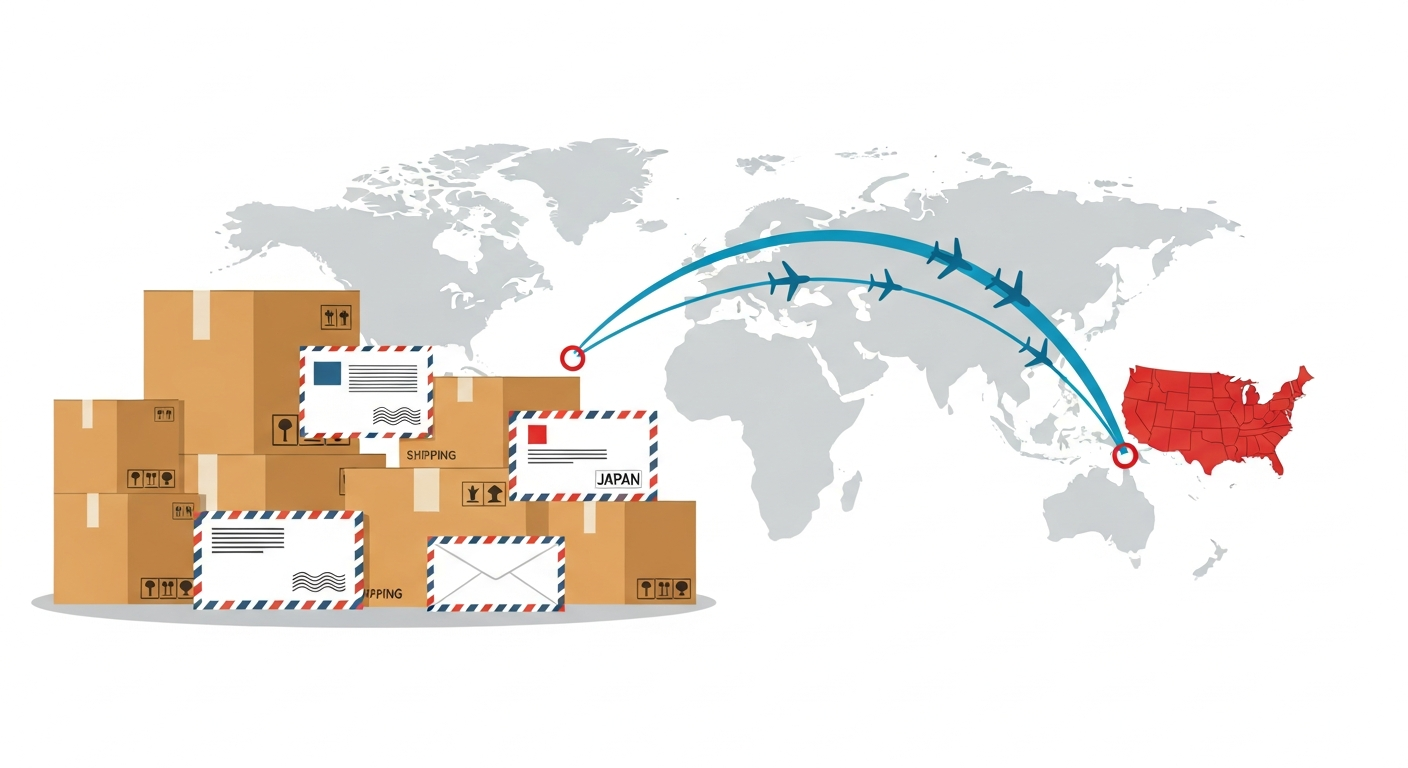
Japan Post US shipping resumed on April 14, 2026, after an eight-month blackout that stranded half the hobby. Good news — but “resumed” does not mean “back to normal,” and the rules changed again on July 8 and July 24. If you are sitting on a Nendoroid preorder or a Suruga-ya cart right now, the question is not whether the mail moves. It is which route your seller can actually use, and who pays the duty.
I live in Japan and ship boxes out of here regularly, so this is a status check rather than a history lesson: what works today, what is quietly on hold, and where the money leaks. Last updated: August 17, 2026. All fees and rules verified against carrier and government pages on August 17, 2026. Exchange rate used: ¥159 = $1 (mid-market, mid-August 2026).
The short answer, checked August 17, 2026
What works
- Japan Post accepts US-bound mail again — EMS, airmail parcels, and surface/sea — but for anything over $100 in value, the sender must prepay US duty through a CBP-certified app. Japan Post currently names Zonos as the only certified provider, and those items are only accepted at designated post offices.
- Every major proxy is shipping to the US, all on a duty-prepaid (DDP) basis. Pay-on-delivery is gone for the US market.
- Direct shops are back too — AmiAmi, HobbyLink Japan, and CDJapan all have working US routes, though with different carriers than in 2024.
- The duty rate is 12.5% on most hobby goods since July 24, 2026, when the Section 122 surcharge expired and Section 301 forced-labor tariffs replaced it. Our running tariff tracker explains what the 12.5% actually applies to.
What is still broken
- Orders in the $800–$2,500 band got worse, not better, on July 24 (explained below).
- CPSC eFiling, mandatory since July 8, 2026, is holding some toy and figure shipments while shops sort out paperwork.
- Some proxies still gate the postal route by parcel value, which pushes you onto couriers whether you wanted them or not.
How we got here: the 12-month timeline
You need three of these dates to make sense of any shop’s shipping page.
| Date | What happened | What it meant for buyers |
|---|---|---|
| Aug 29, 2025 | US de minimis exemption suspended for postal goods | The $800 duty-free window closed; Japan Post stopped accepting US-bound merchandise |
| Feb 24, 2026 | Section 122 surcharge takes effect | Flat 10% on most goods |
| Apr 14, 2026 | Japan Post resumes US-bound mail | Postal routes return, but with sender-side duty prepay via Zonos for $100–$800 |
| Jun 24, 2026 | Interim final rule makes the de minimis suspension indefinite | No “it’ll come back next year” planning |
| Jul 8, 2026 | CPSC eFiling becomes mandatory | Safety-certificate data required at entry; some figure shipments held |
| Jul 24, 2026 | Section 122 expires; Section 301 replaces it; new postal informal entry process starts | Rate moves to 12.5%; prepay band widens to $100–$2,500 |
Channel-by-channel status: what actually works now
| Route | Who handles duty | Status (Aug 17, 2026) | Best for |
|---|---|---|---|
| Proxy + courier (DHL/FedEx/UPS) | Proxy prepays, bills you | Working, most predictable | Auctions, Mercari, anything time-sensitive |
| Proxy + Japan Post | Proxy prepays, sometimes value-gated | Working but restricted at some proxies | Heavy, low-value boxes |
| Direct shop (AmiAmi, HLJ, CDJapan) | Shop prepays or bundles into shipping | Working; some CPSC-related holds | New releases and preorders |
| eBay Japan sellers | Seller must use DDP under $2,500 | Working | One-off vintage items |
| Mercari’s global app | Mercari prepays | Working | Casual Mercari buyers |
Proxy services
Buyee moved to mandatory DDP for the US in August 2025 and switched from a flat 15.5% estimate to per-category duty rates on April 21, 2026, which is a real improvement: you see an estimated duty before you bid instead of after. ZenMarket added prepaid duties for DHL, UPS, and FedEx, but its April 20, 2026 notice said the Japan Post route only supports parcels valued over $800 — that rule was written around the old no-prepay threshold, so check it at checkout now that the threshold has moved to $2,500.
Practical consequence: the “cheap postal option” you remember may simply not appear in your proxy’s dropdown, and the courier quote that replaces it is where the cost hides. Run the numbers before you commit with our proxy fee calculator.
Japanese shops that ship direct
AmiAmi is shipping to the US via ECMS (air) and Surface Mail Premium, both structured so nothing is collected at your door — the import handling is baked into the shipping price. DHL Express remains pay-at-delivery for import charges. HobbyLink Japan restored a range of methods including Japan Post airmail options from May 13, 2026. CDJapan ships via ECMS with duties prepaid at purchase, and usefully notes that CDs, DVDs, Blu-rays, games, LPs, and books stay duty-exempt — informational material is treated differently from plastic. If half your order is doujinshi or artbooks, splitting it from the figures can be worth the extra shipping.
Marketplaces
eBay requires sellers in Japan to use DDP logistics for items under $2,500 to the US, with Authenticity Guarantee items excepted. Mercari’s global app handles duty for you, which is convenient but changes the fee math against a proxy — we broke that down in our Mercari global app versus proxy comparison.
The two rules that decide your route
The value bands: $100 and $2,500
Japan Post’s July 14, 2026 notice confirmed that from July 24, the maximum content value for postal items subject to duty prepayment rose from $800 to $2,500. Read that carefully, because most coverage got the direction wrong:
- $100 or less (documents, genuine gifts): duty-free, no prepay, accepted at any post office.
- $100–$2,500: prepay required, designated offices only.
- Over $2,500: no prepay — but that is not a discount. Duty is collected through a different entry path, typically with brokerage fees on top.
So an $1,800 order that could ship postally without prepay in June now falls inside the prepay band. The widening pulled mid-value orders into the prepay system rather than out of it. If a shop’s shipping page still describes an $800 line, it has not been updated since July.
One more Japan-side detail people miss: items over ¥200,000 (about $1,260) require a Japanese export declaration, which adds a day or two at the counter.
CPSC eFiling: the rule that holds figure orders
Since July 8, 2026, importers must electronically file certificate-of-compliance data with CBP for regulated consumer products. The CPSC’s own announcement confirms this applies regardless of shipment value, including direct-to-consumer parcels. Whether a given scale figure is a “children’s product” is a judgment call about intended age range, and that ambiguity is exactly why some shops paused specific shipping methods in July while they built the filing workflow. Separately, mail shipments flagged for partner-agency requirements are excluded from the new streamlined postal entry process, which is the mechanical reason a toy parcel can sit still while a doujinshi parcel sails through.
What it costs: a ¥28,000 order, three ways
Say you win two figures on Mercari totaling ¥28,000 (about $176) in a 2.6 kg box. Duty is 12.5% either way; the difference is in the surrounding fees.
| Route | Duty | Prepay/handling | What you notice |
|---|---|---|---|
| Proxy + Japan Post (if offered) | ~$22 | Prepay service fee, usually a few dollars | Cheapest total, slowest, tracking varies by service |
| Proxy + courier DDP | ~$22 | Bundled into the quote | Fast and predictable, but volumetric weight can double the freight |
| Direct shop, duty included | ~$22 | Baked into shipping price | Simplest, but you cannot consolidate with other sellers |
The duty line is the smallest variable here. On a 2.6 kg box measuring 50×35×30 cm, a courier bills you for 10.5 kg of volumetric weight — a swing worth far more than $22. That trap is the whole subject of our cheapest-way-to-ship guide, and it has not changed with the new rules.
Bottom line: what I would do today
Keep single parcels under $800 in declared value where you can, ship them duty-prepaid through whatever route your proxy or shop offers, and stop optimizing for the duty percentage — optimize for box dimensions. If your order is genuinely large, either split it or accept that you are entering brokerage territory and price that in before you click.
Mistakes worth avoiding right now
- Trusting a shipping FAQ without a date on it. Three rule changes have landed since April. If the page says “$800” or “10%,” it is stale.
- Assuming “no prepay required” means cheaper. Above $2,500 you pay through a different door, usually with fees attached.
- Declaring a low value to dodge duty. Under-declaring is customs fraud, and your proxy declares the invoice amount regardless.
- Mixing books and figures in one box. Print media is duty-exempt; bundling it with plastic can drag it into the dutiable total.
- Preordering a figure without checking the shop’s current US method. A June-era shipping choice may not exist when the item lands in December.
This article is a shopper’s summary, not legal or customs advice. Duty rates, entry procedures, and carrier policies are changing on a matter of weeks in 2026 — confirm the current rule with the carrier or CBP before a large purchase.
Leave a Reply